Create strategic low-ticket offers that attract the right buyers, work inside collaborations and funnels, and move people naturally into your higher-ticket world.

Your low-ticket offers are growing your list. Are they growing your business, or just attracting people you can't serve?
You've been creating low-ticket products. For bundles. For collaborations. For funnels.
But quietly, something isn't sitting right. The buyers coming in from those offers don't feel quite aligned. They're nice people, but they're not the people you built your higher-ticket programs for. They ask different questions. They have different budgets. They need different things.
And your core offers — the ones you're most proud of, the ones that create the results you actually want to create — those still feel hard to sell.
The problem isn't the price. It's the positioning. Your low-ticket offers are doing the job they were designed to do. They were just designed for the wrong person.
Low-ticket offers don't just generate entry revenue. They decide who enters your world. Design them wrong, and you spend years attracting people you can't take further.
I built an entire low-ticket ecosystem that attracted exactly the wrong people.
When I discovered collaborations, I was all in. Bundles, summits, swaps…every event I could find. And every collaboration needed a low-ticket product to submit. So I started creating.
Around the same time, I was learning about automations and funnels. And every funnel strategy I came across needed a low-ticket offer at the front, an instant monetisation point for new subscribers. So I needed more products.
The problem was that I didn't really know how to create low-ticket offers strategically. So I defaulted to what made sense at the time: create something for beginners. That's what low-ticket offers are for, right? Entry level. Beginner-friendly. Accessible.
So every single one of my low-ticket offers was designed for absolute beginners. The collaborations I joined attracted beginners. My funnels attracted beginners. And over time, my entire business started filling up with beginners, people who were never going to move into my higher-ticket programs because those programs weren't built for where they were starting from.
I had created a perfectly functioning system that funnelled in exactly the people I wasn't trying to reach.
And on top of that, I had too many of them. Overlapping offers. Similar topics. People had no idea which one to buy, or why they'd need more than one.
When I finally stopped and looked at what I'd built, I realised low-ticket offers had been doing exactly what I'd designed them to do. The issue was the design.
I didn't need to stop creating low-ticket offers. I needed to create them differently, with a specific role, positioned for the right person at the right stage, built quickly without wasting time, and packaged in a way that actually sold.
The six fast-track creation methods came from figuring out how to build these quickly without losing quality. The sales page framework came from realising that packaging is what sells a great offer, but a weak package stays invisible.
Low Ticket Playbook is everything I learned from getting this wrong, then getting it right.
The real problem isn't that low-ticket offers don't work. It's that most of them are positioned for the wrong person.

Default low-ticket strategy says: make something simple, price it low, appeal to as many people as possible. Which usually means: make it for beginners.
But if your core offers aren't for beginners, if your best work is with someone who's already tried to lose the weight, already attempted the mindset shift, already been through a relationship program or two, then beginner-positioned entry offers are actively working against you. They filter in the wrong people and filter out the right ones.
A strategic low-ticket offer is positioned for the person who belongs in your ecosystem. It reflects your real methodology at an accessible price point. It creates a buying experience that prepares someone for what comes next, not just any next thing, but your next thing specifically.
And it's built to work everywhere: as a collaboration submission, as a tripwire, as a funnel entry point, as an order bump. One offer. Multiple roles. Designed once, used indefinitely.
What it looks like when low-ticket isn't working strategically:
🙆🏻♀️ Your entry offers attract a different audience than your higher-ticket programs serve
🙆🏻♀️ You have multiple overlapping low-ticket products with no clear distinction between them
🙆🏻♀️ Bundles and collaborations grow your list, but it doesn't move people toward your core offers
🙆🏻♀️ You don't know what to create, so you default to beginner topics or just keep creating more
🙆🏻♀️ Your funnels have low-ticket offers, but the conversion to higher-ticket is weak
🙆🏻♀️ You feel like low-ticket is cheapening your brand rather than strengthening it
What changes when low-ticket is designed right:
🙋🏻♀️ Your entry offer attracts people who are ready for your ecosystem, not just ready for anything cheap
🙋🏻♀️ One strategic offer works across collaborations, funnels, tripwires, and order bumps
🙋🏻♀️ The people entering at low ticket naturally move toward your higher-ticket offers because the positioning is aligned
🙋🏻♀️ You can create a new low-ticket offer quickly when you need one, without losing days to the process
🙋🏻♀️ Your collaborations generate the right kind of list growth, not just volume
🙋🏻♀️ Low-ticket becomes the asset it was always supposed to be: an entry point that compounds
Here's what's inside the Low Ticket Playbook
MODULE 1: Low Ticket Offer Foundations
The foundation that changes how you think about low-ticket entirely. You'll understand the real role low-ticket offers play in a healthy ecosystem, why scaling micro before scaling big is the smarter growth path, what actually makes a low-ticket offer great versus weak, and the essentials every entry offer needs to do its job properly. After this module, creating random beginner products stops making sense, and building intentional entry offers starts.
MODULE 2: Low Ticket Offer Creation
The practical module where the offer gets built. You'll work through how to choose the right idea for your specific ecosystem and audience stage, the six fast-track creation methods that let you move quickly without sacrificing quality, how to deliver your offer seamlessly, how to price and position it for the right person (not just anyone who'll pay), the common mistakes that kill low-ticket conversion, and real examples so you can see how it works across different niches. By the end of this module, you have an offer and not just a plan for one.
MODULE 3: Low Ticket Offer Sales Pages
Quick lessons dedicated entirely to packaging and selling your offer, because a great offer in a weak package stays invisible. You'll learn what a low-ticket sales page actually needs to do (it's different from a high-ticket page), the five core sections every page must have, the extra elements that genuinely boost conversion, how to write copy that converts at this price point, the Clear Sales Page Copy Framework you can use as a template, and how to structure the page so people actually read it. You leave with a complete, conversion-ready sales page for your offer.
Everything inside the Low Ticket Playbook:
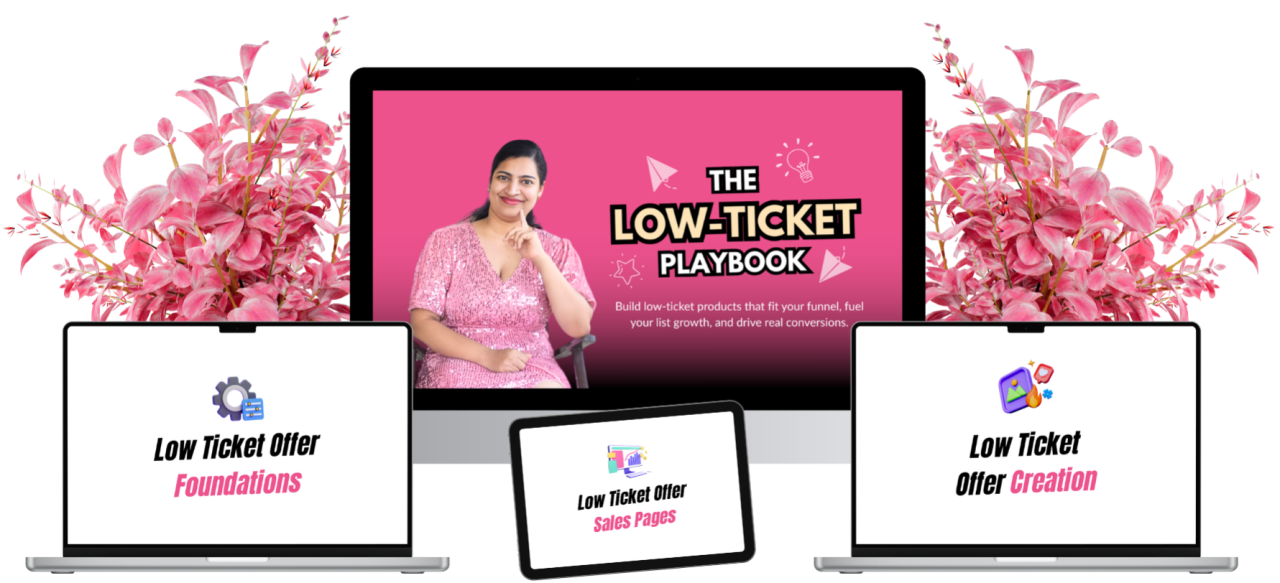
Module 1: Low Ticket Offer Foundations
Module 2: Low Ticket Offer Creation
Module 3: Low Ticket Offer Sales Pages
Lifetime access to all content and future additions
Your Investment: $197
Choose Your Payment Option
One Time Payment
-
- Instant access to the full Low Ticket Playbook curriculum
- Bonus: 10% cashback as Asmita Coins for future purchases on our site.
Two Payments
2 payments of
per month
-
- Instant access to the full Low Ticket Playbook curriculum
Who this is for
This is for you if:
✅ You have core offers and want a strategic low-ticket layer that feeds them and does not compete with them
✅ You participate in bundles and collaborations, and want those to generate buyers and not just subscribers
✅ You've created low-ticket offers before, but they've attracted the wrong people or not converted well
✅ You want to build or rebuild your funnel entry point with real intention behind the positioning
✅ You want to move quickly, with a process that doesn't eat weeks of your time
Not for you if:
❌ You're just starting out with no core offers yet. Build those first, then come back
❌ You want to create more random cheap products. This program will tell you to stop doing that
❌ You're looking for a done-for-you offer, this teaches you the system to build it yourself, fast
Things you might be thinking
Won't a cheap offer attract cheap buyers?
Poorly positioned cheap offers do. That's actually the core insight of this entire program, and the price isn't the problem; the positioning is. When your low-ticket offer is designed for the right person at the right stage, it attracts the people who belong in your ecosystem. Module 1 covers this directly because it's the most common reason people either avoid low-ticket entirely or end up with the wrong buyers coming in.
I already have some low-ticket offers. Do I still need this?
Depends who they're attracting. If the people buying your low-ticket offers are naturally moving toward your higher-ticket programs, great, they're working. If you're seeing a disconnect between your entry buyers and who your core offers are for, that's a positioning issue this program addresses specifically. A lot of people come in with existing low-ticket offers and leave with one of them redesigned and the others retired.
I don't know what to create. Will this help?
Yes, Module 2 starts with exactly this. The lesson on choosing your low-ticket offer idea walks you through a specific process for identifying the right concept for your audience and ecosystem stage. Not just any idea that sounds good, the one that positions you correctly and connects to what you actually sell.
Won't a low-ticket offer cannibalise my higher-ticket programs?
Not when it's designed correctly. An entry offer that reflects your real methodology at an accessible price actually increases the perceived value of your higher-ticket programs. The buyer who's paid $47 for something from you is far more likely to invest in your $497 program than someone who only ever downloaded a freebie, because they've already experienced what you do and decided it's worth paying for.
Do I need the Collab Growth Formula to use this?
No, this stands completely on its own. If you have the Collab Growth Formula, these two work naturally together: CGF teaches you how to choose and participate in collaborations strategically, Low Ticket Playbook teaches you what to bring when you show up. But either works independently of the other.
Why is there a whole module on sales pages?
Because packaging is what sells. You can build the most strategic, well-positioned low-ticket offer and still have it sit there unnoticed if the sales page doesn't do its job. Low-ticket sales pages have specific requirements that generic sales page advice doesn't cover. The buyer's decision-making at $9-$97 is different from $500+; the page needs to move faster, and the copy framework is different. Module 3 is built specifically for this, so your offer actually gets bought.
Do you have a money back guarantee?
We have money back guarantee and credit back guarantee as per our refunds and guarantee page. Please check this out because it differs based on offer pricing. But yes, all of the purchases are covered up by our satisfaction guarantee.
Your low-ticket offers are shaping who enters your world. Make sure they're bringing in the right people.
Every bundle you join, every collaboration you participate in, every funnel you build, they all depend on one thing: a low-ticket offer that attracts the right person and starts the right relationship. Build it strategically.
Build it fast. Package it properly. And watch your collaborations start generating buyers instead of just subscribers.
Low-ticket done right doesn't cheapen your brand. It strengthens it by letting the right people in at the right price."
Get the Low Ticket Playbook for $197 and build the entry offer your ecosystem actually needs.