MICRO-YES MOMENTUM
Buyers didn’t stop buying. What changed is how they commit, and most selling advice hasn’t caught up.
In 2025, selling started feeling heavier. Not just for me, but for almost everyone I was speaking to.
The conversations were the same. Launches felt harder. Offers that had worked before were getting more hesitation. People were watching, engaging, even saying they were interested, and then not buying.
And the advice circulating everywhere was the same: add more urgency, make a bigger promise, increase the bonus stack, push harder.
I tried some of that. It didn’t work. If anything, it made things feel worse.
People just aren’t buying anymore. Maybe the market is saturated. Maybe the economy. Maybe my offer isn’t strong enough.
I was invited to speak at a summit about how buyers are actually making purchasing decisions in 2026. Preparing for that talk made me go back and actually look, and not just assume. I did some direct research with my own list, asking specifically about buying behaviour and what was creating hesitation.
What I found wasn’t what most people were saying. People hadn’t stopped buying. What had changed was how quickly they were willing to commit. That distinction changed everything about how I started structuring my offers. And it’s what Micro-Yes Momentum is built around.
The buying didn’t slow down. The commitment speed did. And those are very different problems.
When sales slow, the natural response is to turn up the volume. More urgency. Stronger promises. Bigger bonuses. Most businesses went in that direction through 2024 and 2025.
What I found when I went back and looked is that it made things worse. And the reason why is what this training is about.
Resistance is not rejection. It’s self-protection.
The hesitation isn’t coming from where most people think it is. And the fix isn’t louder selling. Understanding what actually shifted, and what a micro-yes is, is where the page ends and the training begins.
Right now:
🙆🏻♀️ Sales feel heavier, and you’re not sure why. The offer hasn’t changed, but the hesitation has increased
🙆🏻♀️ You’re adding more urgency, more bonuses, more pressure, and it’s creating more friction, not less
🙆🏻♀️ Buyers say they’re interested and then go quiet
🙆🏻♀️ You’re blaming the offer, the copy, the market, the economy
🙆🏻♀️ Selling feels like convincing, and convincing is exhausting
After Micro-Yes Momentum:
🙋🏻♀️ You understand what actually changed in buyer behaviour and why the old models are creating more resistance
🙋🏻♀️ You know what makes a decision feel safe to a modern buyer, and why that’s a design question, not a pricing question
🙋🏻♀️ You have a different framework for thinking about momentum, one that doesn’t depend on excitement or urgency
🙋🏻♀️ You can see where friction is being added to your offers and how to reduce it
🙋🏻♀️ Selling feels lighter because you’re working with how buyers actually make decisions now, not against it
Here’s what we cover.
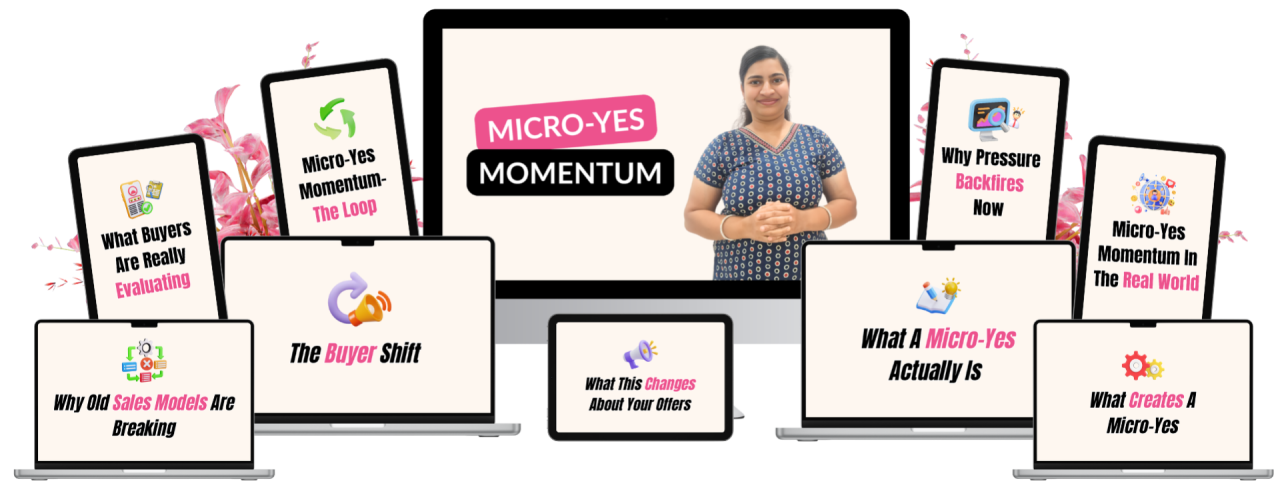
The Buyer Shift
What actually changed in buyer psychology and why it’s not what most people are diagnosing.
Why Old Sales Models Are Breaking
Why the tactics that used to work are now creating the exact friction they were designed to remove.
What A Micro-Yes Actually Is
The definition most people get wrong, and why this has nothing to do with price.
What Creates A Micro-Yes
The conditions that make a decision feel safe enough to take. This is the design lesson.
Micro-Yes Momentum-The Loop
How small forward movement compounds into something most urgency strategies never create.
What Buyers Are Really Evaluating
Not what they say they’re evaluating. What’s actually happening under the hesitation.
Why Pressure Backfires Now
The specific mechanism behind why pushing harder is producing less movement than it used to.
Micro-Yes Momentum In The Real World
What this looks like applied to real offers across different price points and formats.
What This Changes About Your Offers
The practical shift in how you design front-end offers once you understand the framework.
Get Started Here
Who this is for:
✅ You’re already selling, but selling feels heavier than it did, and you’re not sure what changed
✅ You’ve been adding urgency and bonuses, and it’s not moving the needle
✅ You’re curious about buyer psychology and want to understand what’s actually driving hesitation right now
✅ You want a way to think about offer design that’s built around how modern buyers actually make decisions
This is not for you if:
❌ You’re looking for a script or a formula for writing better sales copy. This is a psychological framework, not a copywriting tool
❌ You believe urgency and pressure tactics are still the most effective approach, and you’re not curious about alternatives
❌ You haven’t started selling yet, and this will make much more sense once you’ve experienced the buyer hesitation it addresses
Questions you might have.
Is this just about lowering my prices?
No, and this comes up a lot. A micro-yes is about how a decision is designed, not what it costs. A low-priced offer can still feel emotionally risky. A higher-priced offer can feel completely safe. Price is one variable. It’s not the main one.
Urgency still works for me. Why would I change it?
If it’s working, it’s working. This training isn’t arguing that urgency never converts. It’s explaining why it’s converting less consistently than it used to, and why, for a specific type of buyer, it’s actively increasing hesitation. If you’re noticing slower decisions in your business, this is worth an hour of your time.
My offers are big transformation offers. Does this still apply?
Yes, especially. Big transformation messaging asks buyers to make a significant commitment before they’ve experienced anything from you. This training covers how sequencing changes that dynamic entirely.
How long will this take?
Nine lessons, most between 2 to 4 minutes. The whole training is under 35 minutes. A focused perspective shift, not a long course.
Do you have a money back guarantee?
We have money back guarantee and credit back guarantee as per our refunds and guarantee page. Please check this out because it differs based on offer pricing. But yes, all of the purchases are covered up by our satisfaction guarantee.
Selling isn’t harder because buyers stopped wanting things.

It’s harder because the conditions under which buyers make decisions changed, and most selling advice was built for a different environment.
Understanding what actually shifted is the first step to designing offers and conversations that work with modern buyer psychology instead of against it.
Nine lessons. Under 35 minutes. $9.
People aren’t resisting your offer. They’re protecting their energy. Those are very different problems, and they need very different solutions.